
Clearing your browser's cache and cookies means that website settings (like usernames and passwords) will be deleted and some sites might appear to be a little slower because all of the images have to be loaded again.
Leia mais
After you clear cache and cookies: Some settings on sites get deleted. For example, if you were signed in, you'll need to sign in again. If you turn sync on in Chrome, you'll stay signed into the Google Account you're syncing to in order to delete your data across all your devices.Note: Don't worry, you won't lose any information by clearing your cache. You won't even lose passwords to websites or autofill information from your phone unless you choose to clear that data.

Does deleting cache files do anything
Clearing your cache on Android can free up valuable space and resolve issues with your phone's battery, speed, and security.
In general, I recommend not clearing your cache unless you have a specific reason to. The files in the cache allow the websites you visit most often to load faster, which is a good thing. Your browser will periodically delete old files, so it's not like the cache is going to keep growing forever.The cache is where the browser stores temporary website information. Your passwords are stored in the Password Manager. Your login status is stored in special cookies. The cache is where the browser stores temporary website information.Clearing the system cache can help to resolve issues and improve the performance of your phone by removing temporary files associated with the Android operating system. This process will not delete your files or settings.

While clearing Safari's cache alone will not delete your passwords, clearing your history and cookies can. That's because when you empty your cookies, you will lose their password data saved in Safari as well. And keep in mind that clearing your history also clears its associated cookies.
Does clearing cache delete all data
What Will Clearing Cached Data Do Most devices have some form of cache cleanup. New data comes in, and older information is removed. This system ensures that your device isn't bogged down by so much storage that it can't tackle anything new.
It is a good idea to clear your browser cache because it: prevents you from using old forms. protects your personal information. helps our applications run better on your computer.
Clearing cache is a quick and easy way to free up space and (hopefully) fix a misbehaving app. Clearing app cache will not delete app data like account information.
Leia mais

Storing passwords makes all devices vulnerable
Some viruses and malware can steal the password list remotely. If so, the person responsible for those attacks can access your accounts at any sites you've saved those credentials on.The cache is where the browser stores temporary website information. Your passwords are stored in the Password Manager. Your login status is stored in special cookies. The cache is where the browser stores temporary website information.Clear browsing data.
To delete everything, select All time. Next to "Cookies and site data" and "Cached images and files," check the boxes. Tap Clear data.Clear cache: Deletes temporary data. Some apps can open slower the next time you use them. Clear data storage: Permanently deletes all app data. We recommend trying to delete from inside the app first.
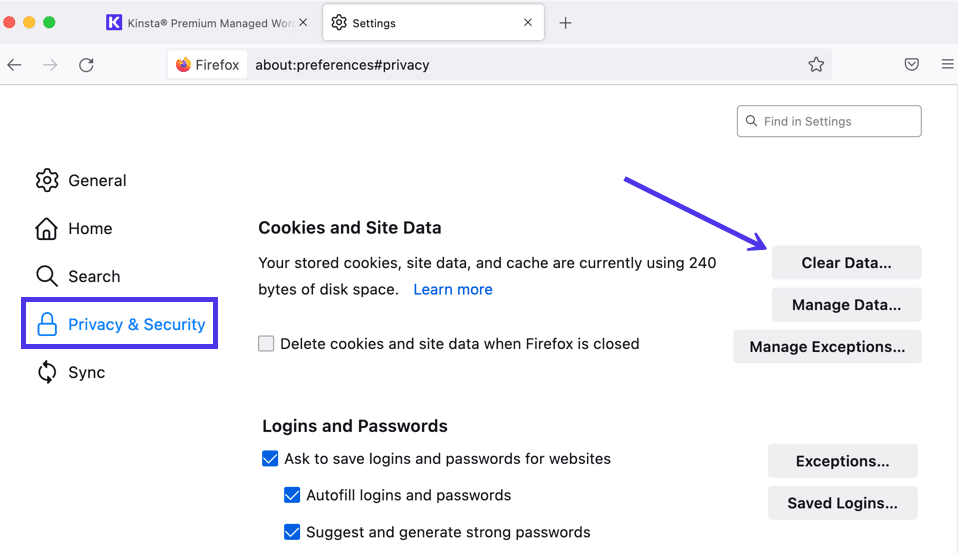
Caches are generally small stores of temporary memory. If they get too large, they can cause performance to degrade. They also can consume memory that other applications might need, negatively impacting application performance.There is no better way to keep your passwords safe than to use a password manager, like Bitwarden. A good password manager should do more than store passwords, such as generate strong passwords and monitor data breaches for compromised passwords.OUR TOP TESTED PRODUCTS
- Dashlane. Best for Security-Focused Extras.
- Keeper Password Manager & Digital Vault. Best for Secure Cross-Platform Password Management.
- Zoho Vault. Best for Sharing Features.
- Bitwarden. Best for Open-Source Password Management.
- LastPass.
- 1Password.
- LogMeOnce Password Management Suite Ultimate.
- NordPass.
You can manage passwords saved to your Google Account at passwords.google.com.
…
To check your saved passwords:
- On your Android phone or tablet, open Chrome .
- At the top right, tap More Settings.
- Tap Password Manager under "Password Checkup," tap Check passwords.

Passwords must be stored in memory (RAM) on a computer so that the operating system is able to validate the password entered by a user.Clearing your cache only gets rid of the data your device has stored from the websites and apps you visit—it has no impact on your photos or the files you have saved there. Regardless of the device, your photos are safe when you clear your cache.If you do not make many webpage alterations or want to see web alterations in real-time you might be better off only clearing your cache once a month or bi-monthly.-Don't use easily guessed passwords, such as “password” or “user.” -Do not choose passwords based upon details that may not be as confidential as you'd expect, such as your birth date, your Social Security or phone number, or names of family members. -Do not use words that can be found in the dictionary.

Unfortunately, that means passwords are decrypted and available for anyone with direct access to the device or via malware that can log in with the user's profile, like the recent RedLine malware. Instead, a password manager requires a dedicated master password that users must enter to decrypt their stored data.The cache is where the browser stores temporary website information. Your passwords are stored in the Password Manager. Your login status is stored in special cookies. The cache is where the browser stores temporary website information.